Giuseppe De Luca, Carlo Pisano, INU – URBIT
MAKING SPACE_GIVING SPACE: two actions that summarize the challenges of contemporary urban planning. MAKING SPACE means opening up margins for maneuver beyond the rigidity of traditional plans. GIVING SPACE means recognizing new actors, practices and forms of governance. The 2025 international conference starts from this double tension to question the future of planning in a context marked by environmental crises, social transformations and territorial emergencies. The conference invites us to reflect on three key issues: how to make space, that is, which tools and approaches can make planning more adaptive; who occupies the space, exploring the role of institutions, collectives, communities and grassroots initiatives; what mechanisms regulate the space, to understand how to balance flexibility and norms, innovation and responsibility. The aim is to open a discussion between scholars, administrators and professionals about capable experiences, theories and practices
to regenerate the relationship between plan and city. MAKING SPACE_ GIVING SPACE thus becomes not only a research topic, but a common horizon for rethinking the governance of the territory, building new possibilities for action and spatial justice.
PROGRAM
Part One
Skins
Carlo Pisano, University of Florence
09:30 – 11:15
First session
How to make space?
Moderate
Stefano Moroni, Polytechnic of Milan
They present
“The new planner spaces. Whether and how new environmental, social and technological challenges are affecting changes in spatial planning”
Vito Garramone, IUAV University of Venice
Barbara Pizzo, University of Rome La Sapienza
“From the PUMS to the urban project: Italy and Holland compared”
Alessia Guaiani, University of Camerino
“The Good the Bad and the Ugly: Make Space for a Project-Oriented Understanding of Urban Regulation”
Davide Pisu, University of Hertfordshire, UK
“Towards negotiated urbanism: principles and instruments of the French model”
Andrea Cusanno, Architect-Urbanist
“Geographies of the possible. Designing conditions in urban voids without a programme, between Italy and the Netherlands”
Nicolò Chierichetti, Polytechnic of Milan
“Dear Piano I’m writing to you”
Marcello Capucci, PhD
11:45 am – 1:30 pm
Second session
Who occupies the space?
Moderate
Patrizia Gabellini, Polytechnic of Milan
They present
“Heuristic uses of art for the investigation and design of urban space. Ideas emerged from The Sensitive City” project
Anita De Franco, Polytechnic of Milan
Jacopo Grilli, The Art of Cities, Amsterdam
“Regenerating Cultural Heritage spaces: strategies and processes in the contemporary city”
Laura Ricci, Paola Nicoletta Imbesi, Francesca Perrone, University of Rome La sapienza
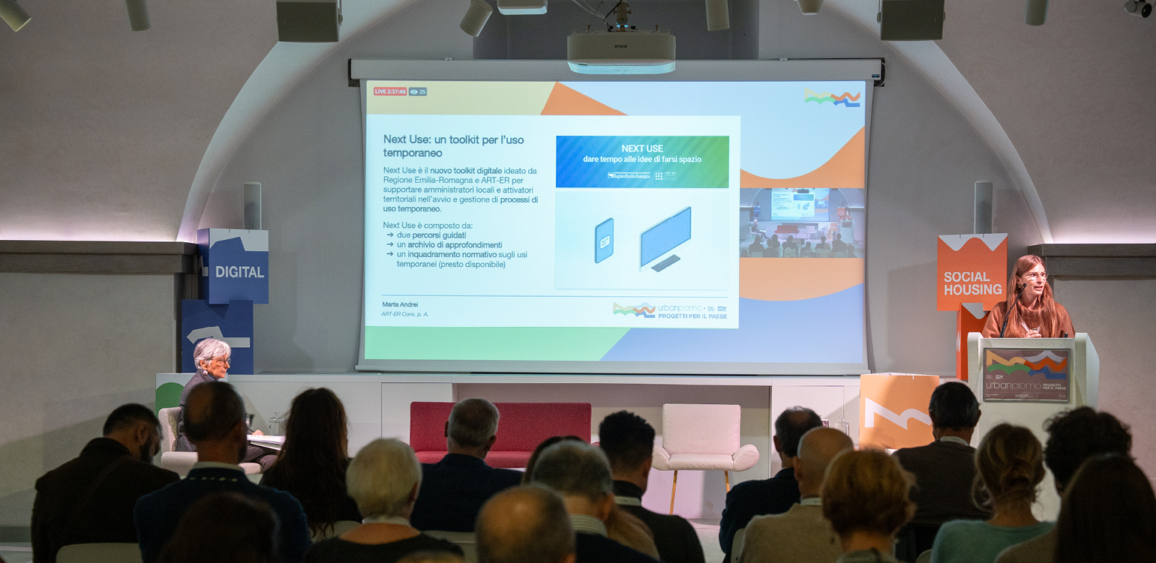
“Give time for ideas to make room for themselves: Next Use and the Emilia-Romagna approach to temporary use”
Marta Andrei, ART-ER
Serena Sgallari, Emilia Romagna Region
“Giving space to social value: tools to evaluate the impact on the community in the transformation processes of urban spaces”
Arianna Brestuglia, University of Florence
“Active Spaces: designing urban spaces with citizens for a shared climate transition”
Michela Tiboni, Michela Nota, University of Brescia
Elena Pivato, Urban Center Brescia
“To form Community. Experiences of regeneration between public policies and social enterprise”
Lorenzo Baldini, CAIRE Consortium
Closing part one
Italiano